Cold Email Writer in your voice
Sales emails in your own voice instead of template-speak — short, specific, and written the way you'd actually type it to one person.
Cold outreach · aiming for 50–120 words · Free account · 5,000 words a month · We don't store your text
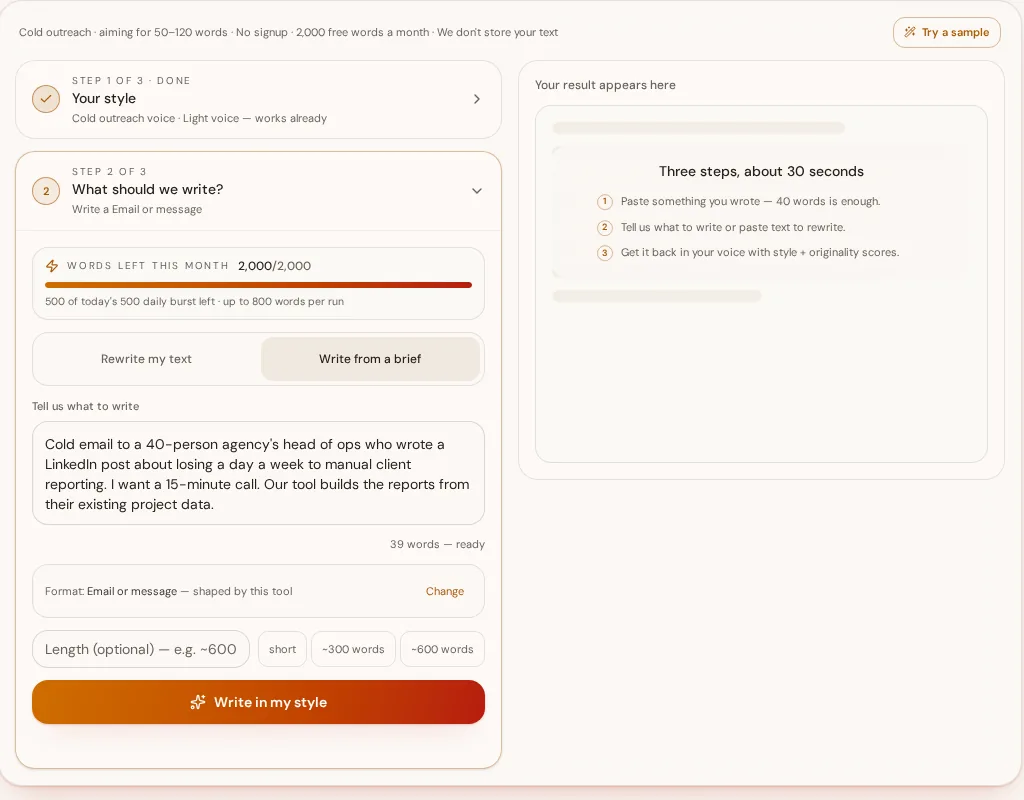
Your result appears here
Three steps, about 30 seconds
- 1Paste something you wrote — 40 words is enough.
- 2Tell us what to write or paste text to rewrite.
- 3Get it back in your voice with style + originality scores.
Free account · 5,000 words a month · We don't store your text
What the Cold outreach does
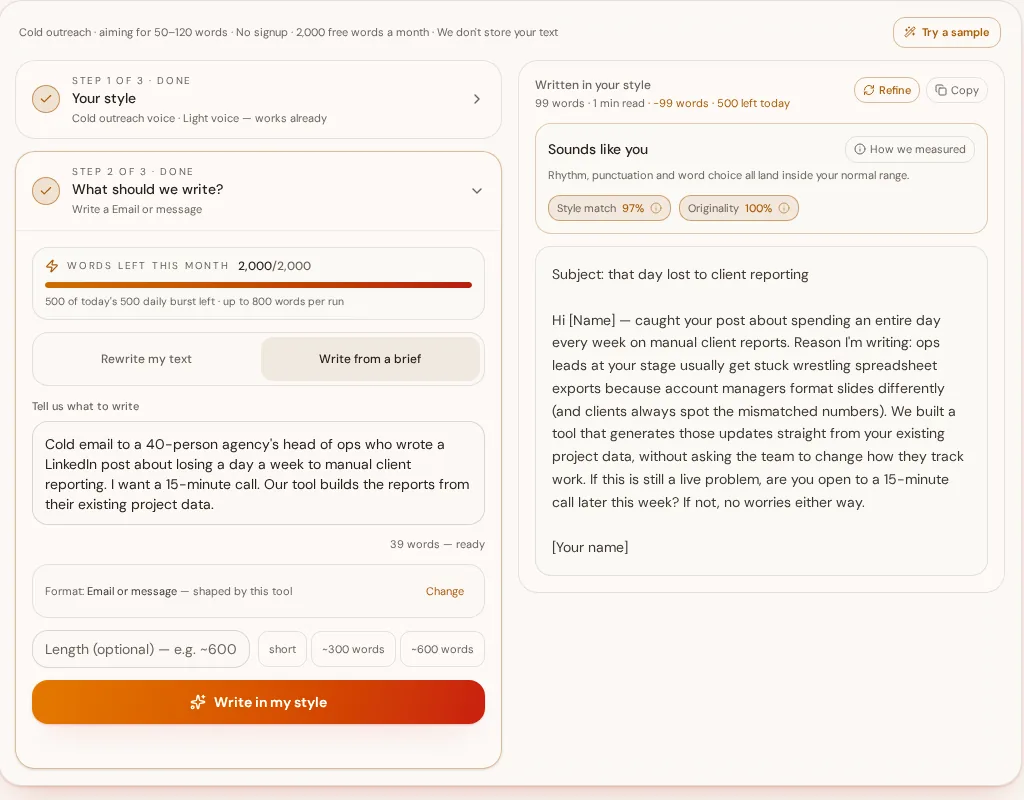
StyleMimic's cold email writer drafts one-to-one outreach in your own voice instead of a template register. You paste 40+ words of emails you have actually sent — ideally ones that got replies — describe the prospect and the single thing you want, and it returns a subject line under 50 characters plus a body under 120 words that opens on the recipient and ends on one low-friction ask. It never invents metrics, case studies or mutual contacts, it is free on a free account, and it drafts single emails you send yourself rather than bulk sequences.
- Subject line
- Under 50 characters, no clickbait or fake re: threads
- Body length
- 50–120 words — cold email is read on a phone
- First line
- About the recipient, never about you or your company
- Ask
- Exactly one, low friction, easy to say yes to
- Invented facts
- Blocked — no fake metrics, logos or mutual contacts
- Price
- Free with an account — 5,000 words a month
How it works — three steps, about 30 seconds
- 1Paste emails you've written that got replies.
- 2Describe the prospect and the one thing you want.
- 3Get a subject line and a short email in your voice.
Before and after
Generic AI output
I hope this email finds you well. My name is John and I'm reaching out from Acme Solutions, a leading provider of innovative software solutions that help companies like yours streamline operations and drive growth.
In the author's style
You mentioned on the Ops podcast that reconciliation still eats two days a month. That's the exact thing we fixed for two other 30-person finance teams. Worth 15 minutes?
- Words
- 34 → 28
- Sentences about the sender first
- 2 → 0
- Filler openers
- 1 → 0
- Asks in the email
- 0 → 1 specific
Opens on the recipient, one concrete reason, one small ask — and it's 30 words instead of 120.
What you actually see
What a cold email writer actually does
A cold email writer turns a short brief — who the prospect is, what you noticed about them, and the single thing you want — into a sendable first-contact email: a subject line under 50 characters, a body under 120 words that opens on the recipient, and one ask small enough to answer from a phone. Cold email is the shortest format in business writing because attention is borrowed rather than given: the recipient never asked to hear from you, so length reads as entitlement.
It is also the format where generic AI output is spotted fastest, because template outreach has been training everyone's filters for a decade. The tells repeat: a compliment the sender clearly did not earn, a paragraph of company positioning before any reason for writing, a stack of unverifiable numbers, and a close that asks for a 30-minute discovery call plus a calendar link plus "or let me know a time that works". Each of those is a reason to archive, and stacked together they are indistinguishable from spam.
StyleMimic starts from outreach you have actually sent instead of a default assistant voice. Paste 40 words or more — the emails that got replies are the useful ones — and they are measured into a style profile: sentence length and variance, punctuation habits, contraction use, how often you hedge, how concrete your nouns are, how you open and how you close. That profile goes to the model as the target, together with a hard format contract: recipient first, under 120 words, exactly one ask, and no invented case studies, metrics, logos or mutual contacts.
That last rule matters more in cold email than anywhere else. A fabricated statistic or a mutual contact who does not exist does not just lose the deal, it is a credibility event you cannot walk back — so facts have to come from your brief. Everything the model adds is phrasing, structure and rhythm. Two scores come back with each draft: style match against your measured profile, and originality as an n-gram check against your own samples, so you are not shipping your last email with the nouns swapped. A words receipt shows what the run cost against the free allowance — 5,000 words a month on a free account.
Nothing here changes your obligations as a sender. Deliverability is decided by authentication, list quality, volume and complaint rate, not by who typed the words, and consent rules still apply — CAN-SPAM in the US, GDPR and PECR in the EU and UK. The realistic promise of a tool like this is narrower and more useful: it removes the reasons a good, well-targeted email gets deleted before the second sentence.
Who uses one
Founders doing their own sales before there is a sales team, agency and consultancy owners writing new-business mail, SDRs who want the first touch to sound human, recruiters contacting passive candidates, and anyone pitching a podcast, publication or partnership one email at a time.
What it is not
It is not a sequencer, a mail-merge or a lead database: nothing is connected to your mailbox, no list is uploaded and no email is sent for you. It is also not a consent workaround — it makes a well-targeted email better, and it makes a badly targeted one exactly as unwelcome as it was before, just shorter.
How to get an email that gets replies
Put the observation in the brief: the podcast episode, the job post, the LinkedIn comment, the specific thing you can see is hard for them. Name the ask and keep it cheap — a reply, a two-minute video, a yes or no — rather than a 30-minute call. Paste real sent outreach as the sample, including the blunt ones. Then read the first line on its own: if it is about you, refine once with "open on the recipient" and it lands.
Further reading
- FTC: CAN-SPAM Act compliance guide for businessSets the US baseline for commercial email — honest subject lines, real sender identity and a working opt-out — which the writer's honest-subject rule is built around.
- Gmail: email sender guidelinesDeliverability is decided by authentication, consent and complaint rate rather than authorship, which is why assisted drafting carries no inbox penalty by itself.
- ICO: direct marketing guidance (UK GDPR and PECR)Explains the lawful basis expected for B2B outreach in the UK and EU — the part a writing tool cannot do for you.
Four tells of generic AI cold outreach output
The unearned compliment opener: "I've been following your incredible work and I'm truly impressed by what you're building."
How we fix it: The format contract requires a concrete, sourced observation from your brief in the first line, so praise that cannot be substantiated has nowhere to sit.
Company positioning before any reason for writing — "a leading provider of innovative solutions that help companies like yours".
How we fix it: The recipient owns the first line and the sender gets the second at the earliest, which forces the email to start with a problem rather than a boilerplate identity.
The value stack: three unverifiable numbers in a row — "cut costs 40%, save 10 hours a week, 3x your pipeline".
How we fix it: Invented metrics, case studies, logos and mutual contacts are blocked outright; only figures you supply in the brief survive into the draft.
The multi-option close — a discovery call, a calendar link and "or whatever time suits" — which is three asks wearing one coat.
How we fix it: Exactly one ask per email, phrased as the cheapest possible yes, so the reply costs the recipient a sentence rather than a diary decision.
What makes a great Cold outreach
- Under 120 words, or it doesn't get read.
- The first line must be about them; the second can be about you.
- One specific reason you're writing to this person, not this segment.
- A single low-friction ask beats a calendar link and three options.
- No fake personalisation and no invented compliments.
What people write with it
Agency and consultancy new-business outreach
The email where a template is fatal, because the recipient gets nine of them a day. Paste the outreach that actually earned you replies and every new draft keeps that register: one observed reason you are writing to this company, one sentence on what you did for someone like them, one small ask.
Founder-led SaaS sales before there is a sales team
Early sales emails work because a founder writes them badly and specifically rather than smoothly and generically. The draft holds under 120 words, opens on the prospect's problem as you described it in the brief, and refuses to add the growth-hacky claims a generic model reaches for.
Recruiting and candidate outreach
Good engineers filter recruiter mail on the first line. Drafts open on something concrete about the person from your brief, state the role and the honest reason it might interest them, and close with a reply-if-curious ask instead of a calendar link and a three-stage process.
Partnership and integration pitches
Partnership mail fails by being about your roadmap. The format contract puts the recipient first and forces one ask, so the email reads as a specific proposal — this integration, this shared customer type — rather than a request for a meeting to explore synergies.
Podcast, press and newsletter pitches
Editors and hosts decide in two lines whether a pitch is targeted. Paste pitches that were accepted, describe the show or publication and the angle, and the draft keeps your phrasing while staying inside the length a busy inbox tolerates.
Follow-ups that don't read as automation
Ask for a follow-up in the brief and reference the previous email: the voice stays consistent across the sequence, the message stays short, and the ask gets easier rather than more insistent — the opposite of what a sequence tool does by default.
Questions
Will it make up details about the prospect?
No. It only uses what you put in the brief — invented metrics, mutual contacts and compliments are explicitly blocked.
Does it write follow-ups?
Yes. Ask for a follow-up in the brief and reference the previous email; the voice stays consistent across the sequence.
Can I keep a team voice?
Save a profile built from your best-performing emails and the whole team can generate from it with a free account.
Is it free?
Yes. A free account includes 5,000 words a month — roughly twenty-five cold emails — and saves your style so every sequence stays consistent.
How long should a cold email be?
50 to 120 words is the band this tool targets. Anything longer is skimmed on a phone and answered later, which in practice means never — the detail belongs in the reply, not the first email.
Does it send emails or connect to my CRM?
No. It drafts one email at a time and you copy it out. Nothing is connected to your mailbox, no list is uploaded and nothing is sent on your behalf, which is also why it can't be used to blast a purchased list.
Is cold email legal?
Commercial email is regulated rather than banned: in the US, CAN-SPAM requires honest subject lines, a valid postal address and a working opt-out, and in the EU and UK, GDPR and PECR expect a legitimate-interest basis for B2B contact. This tool writes the message; consent, targeting and opt-out remain your responsibility.
Will the email look AI-generated?
Each draft is scored for style match against your measured profile and for originality against your own samples, so it can't recycle your old sentences. The tells that give template outreach away — the flattery opener, the value stack, the calendar-link close — are blocked by the format contract.
Related tools
Keep your style in one place
A free account gives you 5,000 words a month and up to 10 saved style profiles. Writing needs an account — scanning a style doesn't.