AI Text Rewriter into your own style
Paste flat AI text and a sample of your own writing. The rewrite keeps the meaning and swaps the voice — measured against your rhythm, not a generic “human” filter.
Text rewriter · Free account · 5,000 words a month · We don't store your text
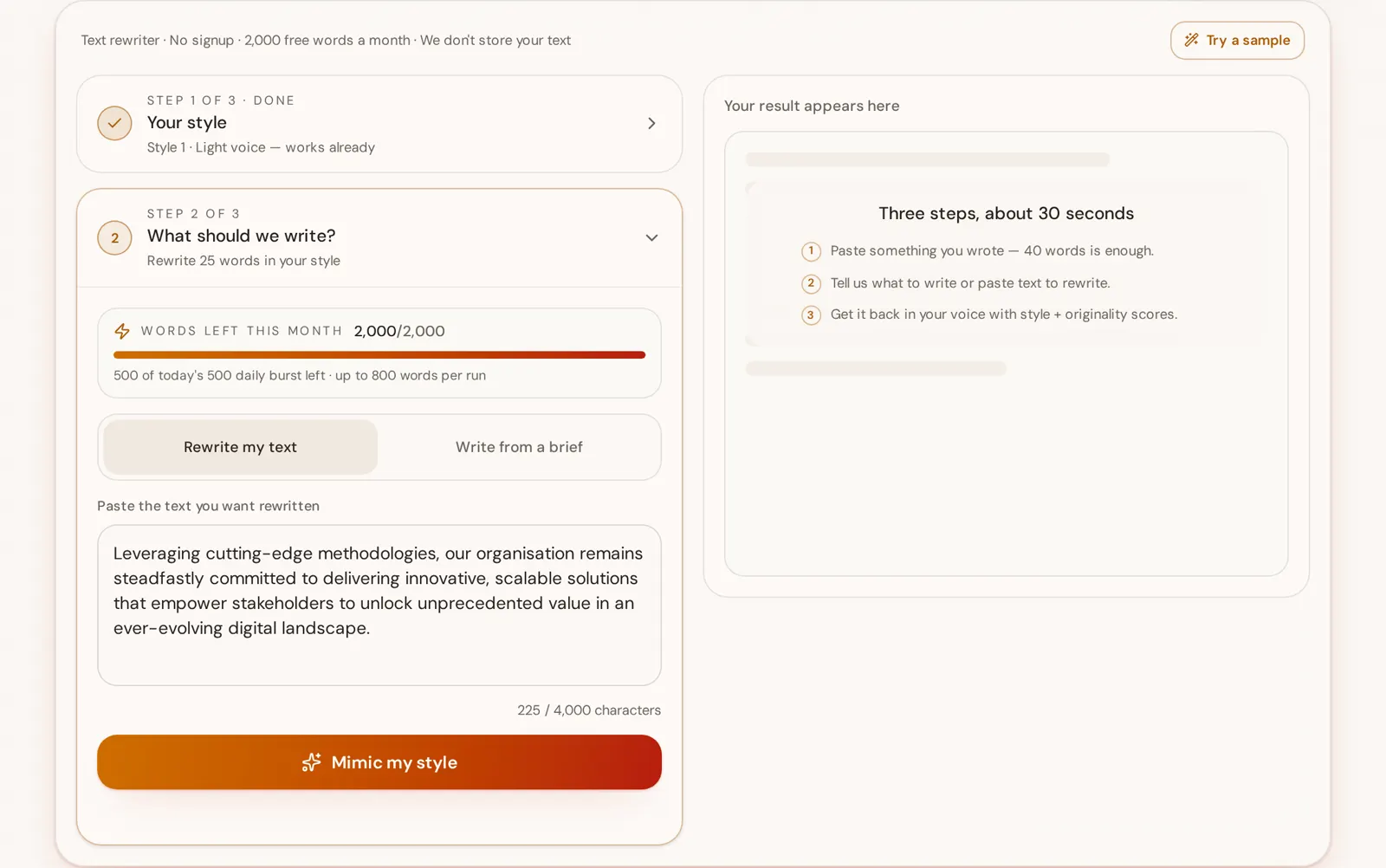
Your result appears here
Three steps, about 30 seconds
- 1Paste something you wrote — 40 words is enough.
- 2Tell us what to write or paste text to rewrite.
- 3Get it back in your voice with style + originality scores.
Free account · 5,000 words a month · We don't store your text
What the Text rewriter does
An AI text rewriter takes a draft you already have — usually one that came out of ChatGPT, Gemini or Claude — and rewrites it sentence by sentence so it reads like you wrote it. StyleMimic does that against a measured profile of your own writing rather than a generic “human” average: paste 40 words or more of anything you have written, paste the draft, and the rewrite comes back with the same facts, the same length and the same order of points, in your rhythm and vocabulary. Every run shows a Style match score and an Originality score so you can see how close it landed instead of guessing. It is free: a free account includes 5,000 words a month.
- Output length
- Mirrors the source text — no summarising, no padding
- Style sample needed
- 40 words minimum, 300+ for the strongest match
- Scores per run
- Style match and Originality, both shown before you copy
- Free allowance
- 5,000 words a month on a free account
- What we keep
- Nothing — your draft is not stored or used for training
- Detector claims
- None. This is style matching, not detector evasion
How it works — three steps, about 30 seconds
- 1Paste a sample of your own writing (40 words is enough).
- 2Paste the AI or draft text you want rewritten.
- 3Get the rewrite with Style match and Originality scores.
Before and after
Generic AI output
Leveraging cutting-edge technology, our team is committed to delivering innovative solutions that empower businesses to unlock their full potential in an ever-evolving marketplace.
In the author's style
We build tools that do one job properly. Right now that job is invoicing, and it works for about 400 small studios who used to do it in a spreadsheet.
- Sentences
- 1 → 2
- Words
- 23 → 30
- Avg sentence length
- 23 → 15 words
- Abstract nouns
- 5 → 0
Meaning intact, voice replaced: shorter sentences, concrete numbers, none of the original's abstractions.
What you actually see
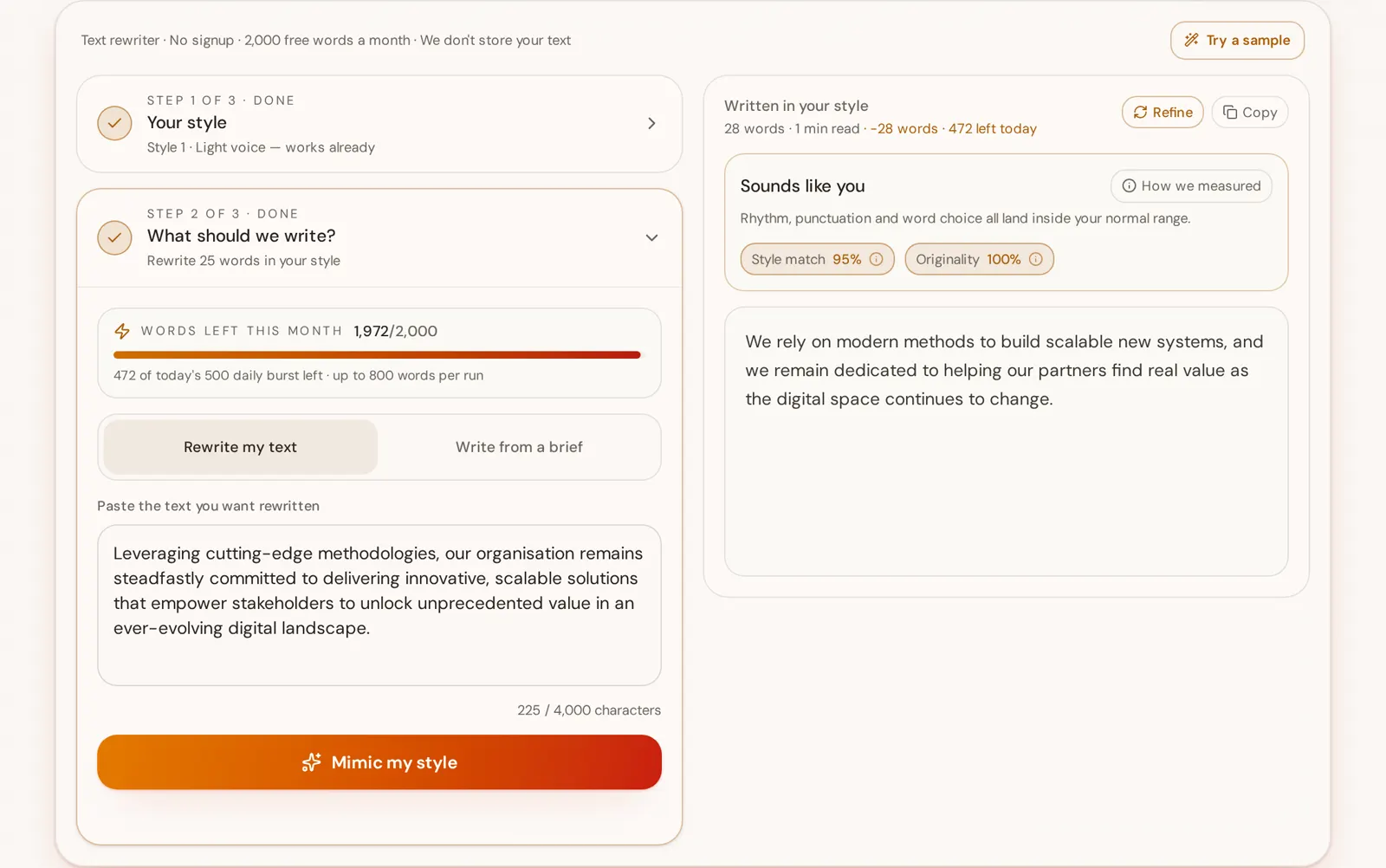
What an AI text rewriter actually does
An AI text rewriter rewrites an existing draft rather than writing a new one from a topic. It works at the level of sentence structure and word choice: the same claims come back in a different cadence. That is a narrower job than generation, and it is the job most people actually have — the draft exists, it just sounds like a machine produced it.
Most rewriters aim at one anonymous target: an averaged idea of how a person writes. That is why their output all sounds alike, and why a page rewritten by one of them still doesn't sound like the person publishing it. StyleMimic aims at a specific target instead. Before the rewrite runs, your sample is measured — average sentence length and how much it varies, comma and dash habits, paragraph length, how often you use first person, how concrete your nouns are — and those numbers are sent to the model as the target the rewrite has to hit.
Two scores come back with every rewrite. Style match compares the finished text against that measured profile, so a low score means the rewrite drifted and is worth one Refine pass. Originality is an n-gram comparison against your sample: it catches the failure mode where a rewriter quietly recycles phrases from the text you pasted instead of writing new sentences in your voice.
Who uses one
Ghostwriters rewriting in a client's voice, founders and operators who draft with ChatGPT but publish under their own name, in-house marketers unifying copy written by five different people, and students and researchers who want their own prose back after an AI-assisted first pass.
What it is not
It is not a detector-evasion service. We make no claim about what any third-party AI detector will say about the output, because those tools disagree with each other and change weekly. It is also not a fact-checker, a summariser or a translator — the rewrite preserves the source's claims and length rather than judging or condensing them.
How to get a good rewrite the first time
Paste a sample that resembles what you are writing: past newsletters for a newsletter, past posts for a post. Longer and more recent beats older and shorter. Then rewrite, read the Style match score, and refine once if it is low — the second pass is usually the one that lands.
Further reading
- Google Search: AI-generated content guidanceGoogle rewards helpful, original content however it was produced — the reason a rewrite should keep your substance rather than disguise it.
- Google Search Essentials: spam policiesScaled content abuse is what mass rewriting for its own sake looks like to a search engine. Rewrite what you would have published anyway.
- Plain-language writing guidelines (plainlanguage.gov)Short sentences, concrete nouns and active verbs — the same measurements the style profile scores.
Four tells of generic AI text rewriter output
Uniform sentence length — every sentence lands within a few words of the last one.
How we fix it: The profile carries your own sentence-length variation, so the rewrite alternates short and long the way you actually do.
Abstraction stacking: “innovative solutions”, “unlock potential”, “drive impact”.
How we fix it: Abstract noun density is measured in your sample and enforced in the rewrite, so vague phrases get replaced with the concrete nouns you use.
Mechanical connectives — “Furthermore”, “Moreover”, “In conclusion” at the head of paragraphs.
How we fix it: Connectives are taken from your sample's inventory instead of the model's defaults; if you never write “Moreover”, the rewrite doesn't either.
Tidy tricolons and symmetrical clauses that no one writes twice in a row by accident.
How we fix it: Punctuation and clause-rhythm targets from your profile break the symmetry, and the Style match score exposes it when a pass is still too neat.
What makes a great Text rewriter
- Meaning stays; rhythm, vocabulary and punctuation move to your profile.
- No sequence of six or more words is copied from your samples.
- Style match tells you how close the rewrite is to your measured style.
- Originality tells you it's your voice, not your old sentences.
- Refine once to push the rewrite further toward your profile.
What people write with it
Rewrite a ChatGPT draft in your own voice
The fastest use: you already have a serviceable draft, it just doesn't sound like you. Paste your sample, paste the draft, and get the same argument back in your cadence.
Make agency or freelance copy sound in-house
Feed it a page of your existing site or newsletter as the sample, then rewrite whatever came back from an external writer so the whole library reads as one voice.
Ghostwrite in a client's voice
Use the client's past posts as the sample instead of your own. The profile is measured from whatever you paste, so it works for any author you have permission to write as.
Rewrite old posts for a new positioning
Bring an archive of posts up to how you write now — the rewriter keeps the claims and numbers intact while the phrasing moves.
Turn rough notes into publishable prose
Paste bullet notes as the draft. The rewrite keeps every point in order and puts them into sentences that match your style.
Tighten a paragraph that runs long
Rewrite, then hit Refine once. Each pass pushes sentence length and word choice further toward your measured profile.
Questions
Is this an AI humanizer?
It's a style rewriter. Instead of pushing text toward a generic “human” average, it rewrites toward a measured profile of how you specifically write. We don't promise anything about third-party AI detectors.
What is the Originality score?
An n-gram comparison against your samples. High originality means the rewrite is new text in your voice rather than a reshuffle of what you pasted.
How long can the text be?
Long enough for full posts and articles; very long documents work better split into sections.
Is it free?
Yes — 5,000 words a month on a free account, at no cost and no card.
Do I need to sign up to rewrite text?
Not for writing: a free account is required, and it includes 5,000 words a month plus saved named style profiles so you don't paste the same sample twice. Scanning a style and reading the analysis works without an account.
How much of my own writing do I need to paste?
Forty words is enough to unlock a rewrite, though the profile is called low confidence at that length. Around 120 words gives a solid match, and 300 or more gives the strongest one because sentence-length variation and punctuation habits become measurable.
Will the rewrite change my facts or numbers?
No. The format contract sent with every rewrite says to preserve every fact, number, name and claim exactly as given and to add none, so the rewriter changes voice, rhythm and word choice only. Always read the result before publishing.
Can I rewrite text in someone else's writing style?
Yes, if you have their writing. The style profile is measured from whatever sample you paste, so ghostwriters routinely use a client's past posts. Copying a living author's voice to impersonate them is not something we support.
Does the rewriter keep my text?
No. Your draft and sample are sent to the model to produce the rewrite and are not stored on our side or used to train anything. Saved style profiles are the one exception, and only when you are signed in and choose to save one.
How this works, in full
Related tools
Keep your style in one place
A free account gives you 5,000 words a month and up to 10 saved style profiles. Writing needs an account — scanning a style doesn't.