AI Article Writer in your byline voice
Turn your archive into first drafts: paste published pieces, give the angle, and get long-form text that keeps your structure, your rhythm and your opinions.
Article & blog · aiming for 600–1200 words · Free account · 5,000 words a month · We don't store your text
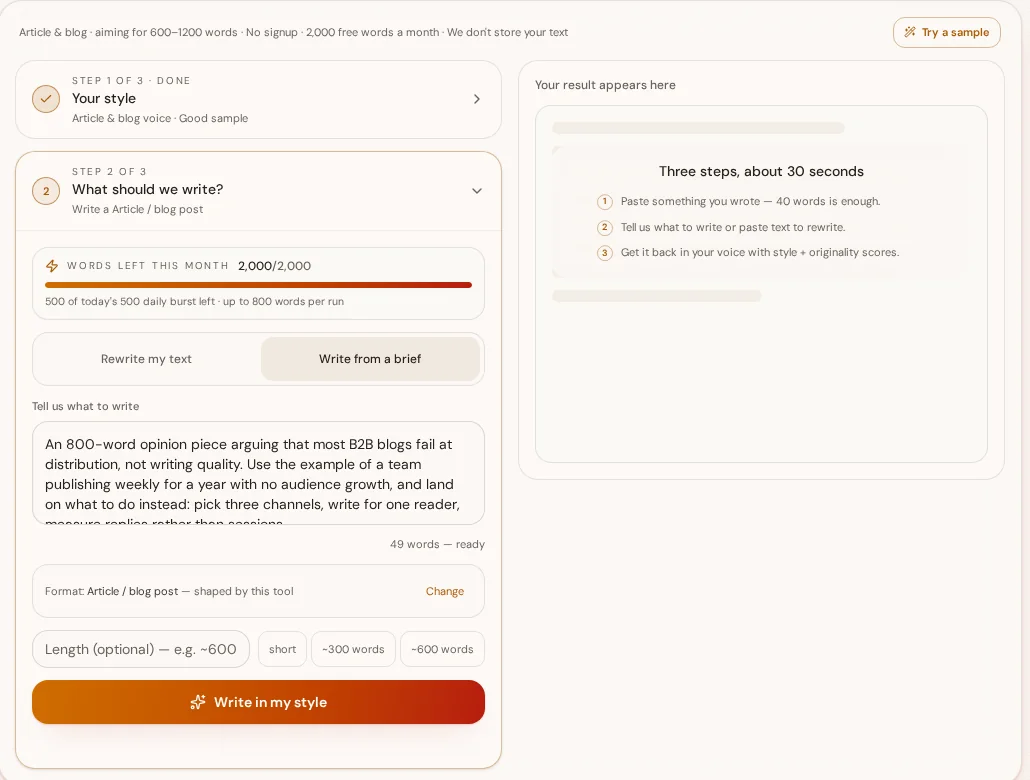
Your result appears here
Three steps, about 30 seconds
- 1Paste something you wrote — 40 words is enough.
- 2Tell us what to write or paste text to rewrite.
- 3Get it back in your voice with style + originality scores.
Free account · 5,000 words a month · We don't store your text
What the Article & blog does
StyleMimic's article writer drafts long-form blog posts and essays in your own byline voice instead of a generic assistant register. You paste 40 words or more of writing you have published — a full article is better, because long-form needs a wider sample — describe the angle and roughly how long the piece should be, and it returns a 600–1,200 word draft that keeps your paragraph length, sentence rhythm and opinions. It never invents statistics, quotes, names or sources, every draft comes back with a style-match and an originality score, and it is free on a free account.
- Draft length
- 600–1,200 words per run; longer pieces section by section
- Opening
- A claim, scene or tension — never a definition or 'in today's world'
- Structure
- One argument per section; subheads only if your samples use them
- Invented facts
- Blocked — no fabricated numbers, quotes, names or sources
- Sample for long-form
- 40 words unlocks it; 300+ gives high confidence
- Price
- Free with an account — 5,000 words a month
How it works — three steps, about 30 seconds
- 1Paste one or two of your published articles as the style sample.
- 2Describe the angle and roughly how long it should be.
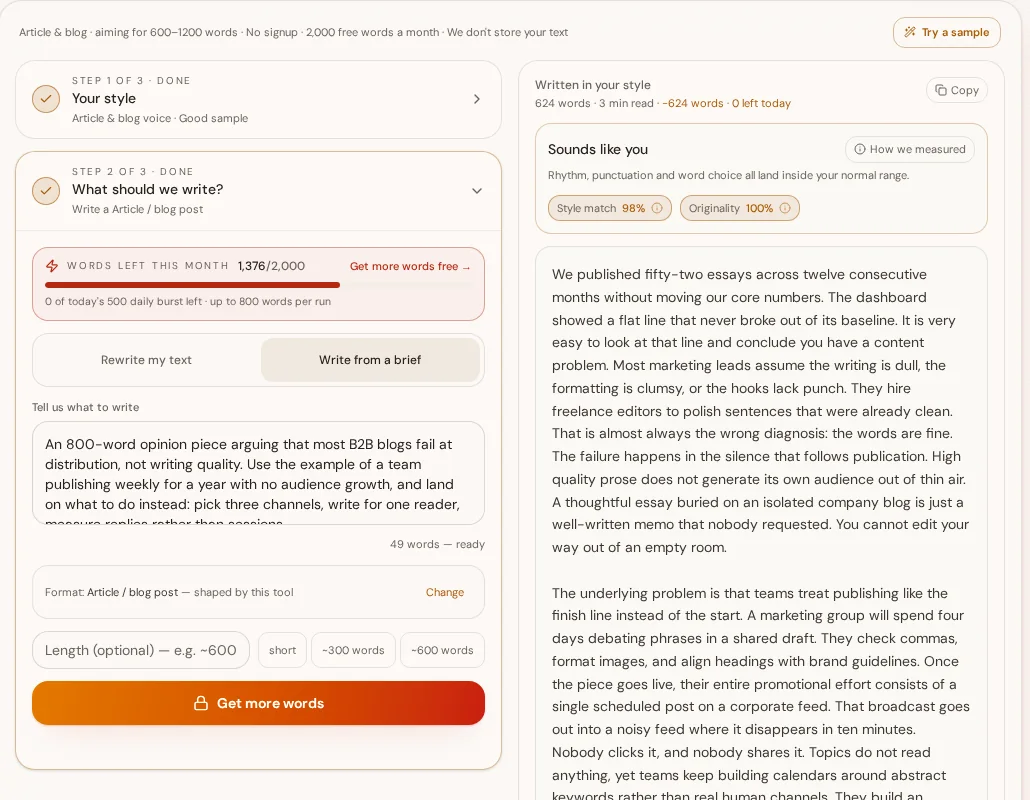
- 3Get a full draft with Style match and Originality scores, then refine.
Before and after
Generic AI output
In today's fast-paced digital landscape, content marketing has become an essential tool for businesses looking to grow their online presence and engage their target audience effectively.
In the author's style
Most content marketing fails for a boring reason: nobody on the team can say who the post is for. We shipped 40 articles last year. Six did all the work.
- Words in the opener
- 26 → 29 across 3 sentences
- Words before the first claim
- 26 → 0
- Abstract nouns
- 6 → 1
- Concrete numbers
- 0 → 2
Same topic, but the opener commits to a claim, drops the throat-clearing, and matches the author's short-sentence rhythm.
What you actually see
What an AI article writer actually does
An AI article writer turns an angle and a length target into a long-form draft: 600 to 1,200 words with a real opening, sections that each carry an argument, and a close that lands rather than summarises. The useful version of this is not a topic-to-text machine. It is a drafting tool that removes the slowest part of publishing — getting 900 coherent words onto the page — while leaving the thinking, the facts and the final edit with you.
Long-form is where generic AI writing is easiest to spot, and the reason is arithmetic. A social post gives a model 40 words to sound like nobody in particular; an article gives it 900, and the default patterns compound. You get the throat-clearing intro that explains why the topic matters before saying anything, the tricolon habit where every point arrives in threes, sentences that all land within a few words of the same length, section transitions built from "moreover" and "furthermore", and a final paragraph that restates the first one in a suit. Readers do not identify these individually; they just stop reading.
StyleMimic starts from writing you have already published rather than a house assistant voice. Paste an article — for long-form, aim past 300 words, because a wide sample is what keeps a voice stable across a thousand — and it is measured into a style profile: sentence length and variance, paragraph length, punctuation habits, contraction rate, how often you hedge, how concrete your nouns are, whether you use subheads at all. That profile is given to the model as the target alongside a hard format contract: open on a claim or scene, one argument per section, no listicle padding, no summary paragraph unless your own samples have one, and never invent a number, quote, name or source.
The no-invented-facts rule is what makes long-form drafting safe to use. Fabricated statistics are the single most expensive failure mode in published content, so anything verifiable has to arrive through your brief; what the model contributes is phrasing, structure and rhythm. Two scores come back with every draft. Style match compares the output against your measured profile so you can see whether it actually sounds like you before you edit. Originality runs an n-gram check against your own samples, which matters more in long-form than anywhere else — without it, a model handed 900 words of your writing will happily hand back your own paragraphs with the nouns changed. A words receipt shows the run's cost against your allowance: 5,000 words a month on a free account.
For pieces longer than about 1,200 words, generate section by section against the same saved profile instead of asking for the whole thing at once. Quality degrades with length in every model, and one profile across several runs holds the voice better than a single long generation. Then edit — properly. Search-engine guidance is explicit that helpfulness and originality are what get judged, not the tooling; a draft in your voice with your facts is a strong starting point and still a starting point.
Who uses one
Bloggers and independent writers turning a backlog of ideas into published pieces, ghostwriters producing founder bylines, content teams holding one house voice across many authors, consultants writing analysis between client work, and SEO teams that need drafts which survive an editorial pass.
What it is not
It is not a research tool, a fact checker or a publish-and-forget content mill. It does not browse, it does not cite, and it will not fill a section with statistics to look authoritative. Anything a reader could check has to come from you — the draft is prose, not evidence.
How to get a draft worth editing
Paste one full published article rather than three fragments; long-form rewards sample width. Put the argument in the brief, not just the topic — "most B2B blogs fail at distribution, not writing" produces a piece, "content marketing" produces filler. Name the length. Include the facts and examples you want used. Then read the first paragraph on its own: if it explains why the topic matters instead of making a claim, refine once with "open on the claim" and the rest of the draft follows.
Further reading
- Google Search: creating helpful, reliable, people-first contentThe standard long-form drafts are judged against — originality, expertise and usefulness rather than production method.
- Google Search: spam policies on scaled content abuseClarifies that automation aimed purely at ranking is the problem, which is why this tool drafts one edited piece at a time rather than bulk output.
- Purdue OWL: paragraphs and paragraphingThe one-argument-per-section rule in the format contract follows standard paragraph-unity guidance.
Four tells of generic AI article & blog output
The throat-clearing intro: "In today's fast-paced digital landscape, content marketing has become an essential tool for businesses…"
How we fix it: The format contract requires the opening to be a claim, scene or tension, so a paragraph that explains why the topic matters before saying anything has nowhere to go.
Tricolon padding — every point arriving in a rhythmic three: "streamline operations, drive growth, and unlock potential".
How we fix it: The measured profile carries your real sentence-length variance and clause habits, so lists are as long as your evidence rather than as long as the cadence wants.
Sections that restate each other with a new subhead, joined by "moreover", "furthermore" and "in addition".
How we fix it: One argument per section is enforced, and subheads only appear if your own samples use them — so structure has to earn its headings.
The mirror-image conclusion: a final paragraph that repeats the introduction in different words and adds "in conclusion".
How we fix it: The draft closes on a thought rather than a summary unless you habitually write summaries, which the profile detects from your samples.
What makes a great Article & blog
- The first paragraph decides whether the piece is read — lead with the sharpest point.
- One argument per section, each one moving the piece forward.
- Concrete examples beat adjectives; abstractions are where AI writing shows.
- Keep your own paragraph length — long-form doesn't mean longer sentences.
- No summary paragraph unless you normally write one.
What people write with it
Turn an outline you already trust into a full draft
You have the argument and the section order; what takes the afternoon is writing 900 words that sound like you. Paste a published piece, put the outline in the brief, and the draft follows your section flow with your paragraph length instead of inflating each heading into a listicle entry.
Expand a rough brief or a set of notes
Meeting notes, a voice memo transcript, three bullet points from a call — paste them as the brief and the draft turns them into connected prose. Facts stay exactly as you gave them: nothing is added to fill a section, because invented numbers and sources are blocked.
Rewrite a research dump in your own voice
Long-form written from research usually reads like the research. Give the material in the brief and your own published article as the sample, and the draft keeps your sentence variance and your habit of committing to a claim early rather than surveying both sides for four paragraphs.
How-to guides and explainers that stay concrete
Explainers are where generic AI writing is most obvious, because abstraction is cheap. The format contract requires each section to add an argument, so steps arrive with the specific detail from your brief instead of a paragraph on why the topic matters before anything useful happens.
Opinion and thought-leadership under a real byline
Ghostwriters and comms teams use this for founder bylines: scan the founder's own writing once, save the profile, and every draft afterwards carries their opinions and their bluntness. Style match tells you how close the draft is before it goes for approval.
Repurpose a long post or talk into an article
A LinkedIn post that worked, a conference talk, a newsletter issue — paste it in the brief and ask for the article version. Originality is scored against your own samples, so you get a genuinely rewritten piece rather than your old text with the nouns swapped.
Questions
How long can an article be?
Comfortably up to about 1,200 words per run. For longer pieces, generate section by section — the same style profile keeps the voice consistent across runs.
Will it invent facts or statistics?
No. The generator is instructed never to invent numbers, quotes, names or sources. It writes opinions, structure and examples; verifiable facts stay yours to add.
How much of my writing do I need to paste?
Forty words unlocks it, but for long-form aim for 300+ words — one full published article gives high confidence.
Is it free?
5,000 words a month on a free account. An 800-word article is roughly a sixth of that, so long-form is the format where a paid plan pays off fastest.
Will the draft look AI-generated?
Every run is scored two ways: style match against your measured profile, and originality as an n-gram check against your own samples. The patterns that give long-form AI text away — the throat-clearing intro, the tricolon padding, the summary paragraph that repeats the intro — are blocked by the format contract rather than left to chance.
Is AI-assisted content a problem for Google?
Google's guidance judges helpfulness and originality rather than how text was produced; automation aimed purely at ranking is what its spam policies target. A draft in your own voice, with your own facts and your own argument, sits on the right side of that line — but you are still the editor of record.
Can I keep one house voice across a whole blog?
Yes. Save a style profile from the pieces that define your house voice and select it in step 1 on any tool. Profiles are global, so the same voice covers articles, newsletters and social posts.
How this works, in full
Related tools
Keep your style in one place
A free account gives you 5,000 words a month and up to 10 saved style profiles. Writing needs an account — scanning a style doesn't.