AI Newsletter Writer in your voice
Draft the next issue from your past issues: same opener habits, same asides, same sign-off — the voice your subscribers actually subscribed to.
Newsletter · aiming for 220–800 words · Free account · 5,000 words a month · We don't store your text
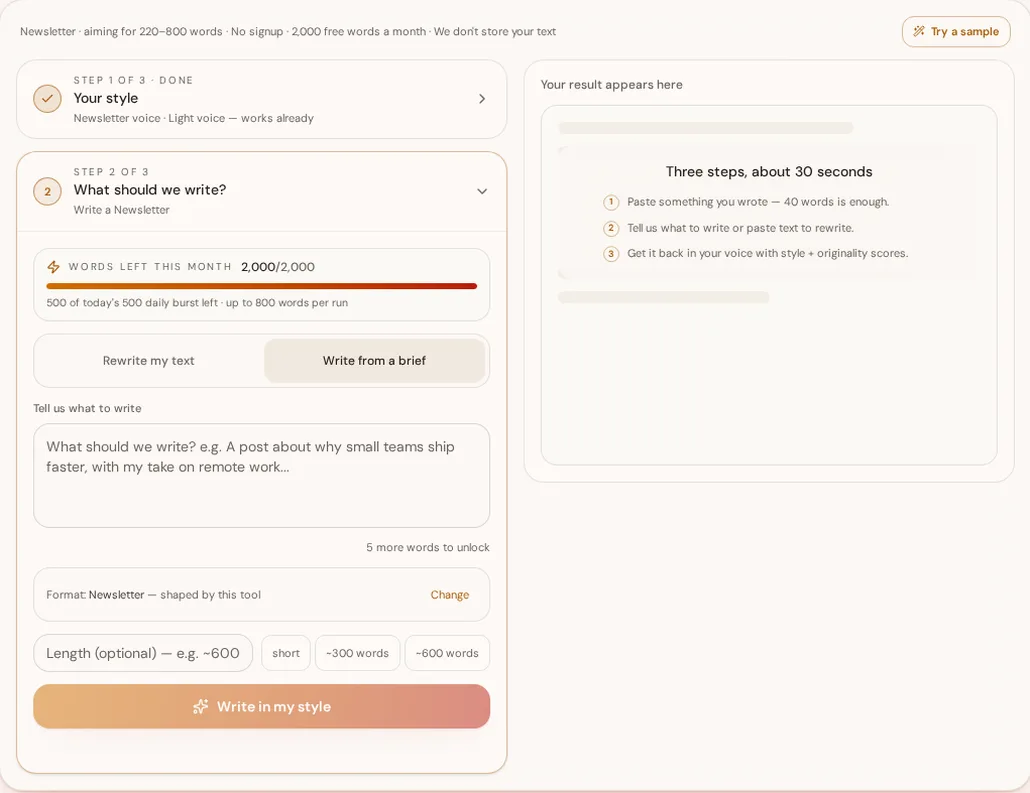
Your result appears here
Three steps, about 30 seconds
- 1Paste something you wrote — 40 words is enough.
- 2Tell us what to write or paste text to rewrite.
- 3Get it back in your voice with style + originality scores.
Free account · 5,000 words a month · We don't store your text
What the Newsletter does
StyleMimic's newsletter writer drafts your next issue in the voice your subscribers already recognise, instead of a generic marketing register. You paste past issues as the style sample — 40 words unlocks it, two or three full issues give high confidence — describe what this issue covers, and it returns a subject line, a preview line and a 220–800 word body that keeps your opener habits, your asides and your usual sign-off. It never invents numbers, quotes or sources, every draft comes back with a style-match and an originality score, and it is free on a free account.
- Issue length
- 220–800 words of body copy per run
- Always included
- Subject line and preview line above the body
- Subject line
- Under 50 characters — inboxes cut the rest
- Structure
- One idea per issue, written to one reader in second person
- Invented facts
- Blocked — no fabricated numbers, quotes, names or sources
- Price
- Free with an account — 5,000 words a month
How it works — three steps, about 30 seconds
- 1Paste two or three past issues as the style sample.
- 2Describe what this issue covers.
- 3Get subject line, preview and body in your voice.
Before and after
Generic AI output
Hello everyone! We are excited to share some updates with you this week. We have been working hard on several new features that we think you will love.
In the author's style
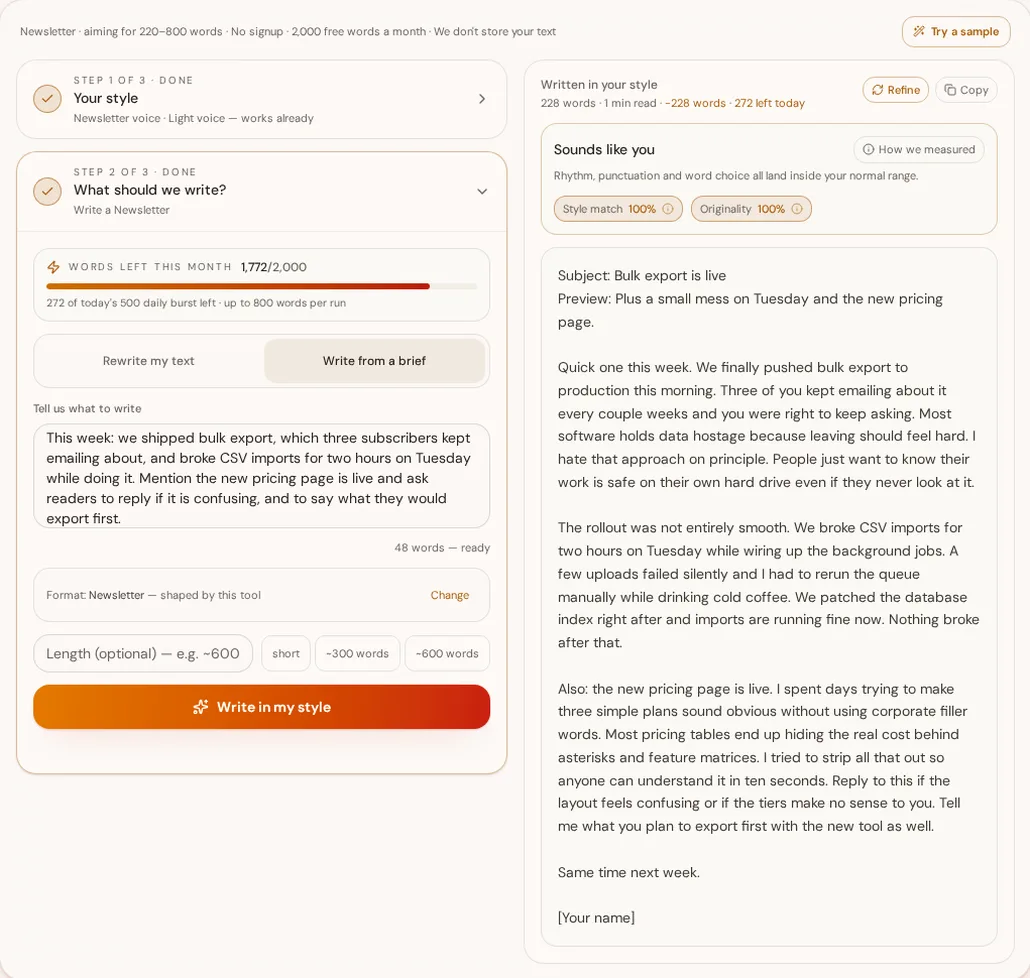
Quick one this week. We shipped the thing three of you kept emailing about — bulk export — and broke something small on the way. Details below, apology included.
- Words to the first specific fact
- 27 → 4
- Sentences
- 3 → 3, average length 9 → 9 words
- Group greetings
- 1 → 0
- Named specifics
- 0 → 2 (bulk export, the breakage)
Keeps the writer's dry, one-reader tone and a specific hook instead of a group greeting.
What you actually see
What an AI newsletter writer actually does
An AI newsletter writer turns "here's what this issue covers" into a sendable draft: a subject line, a preview line and a body of 220 to 800 words written to one reader. The useful version is not a topic-to-email machine. It removes the slowest part of a weekly send — turning a note into paragraphs that sound like you — and leaves the judgement, the facts and the final read-through with you.
Newsletters depend on voice more than any other format, and the reason is the inbox. Nobody arrives at an issue from search; they opened it because they recognised the sender. What subscribers actually recognise is small and specific: how you open, whether you use asides in parentheses, how long your paragraphs run, whether you swear, how you sign off. A generic draft breaks all of that at once, and the churn shows up two issues later rather than immediately, which is why it is easy to miss.
Subject lines are the other place generic generation fails hard. A line that reads fine in a document is a different object in an inbox: it is competing with forty others, it gets truncated around 50 characters on mobile, and the first line of the body is read in the preview pane whether you intended it or not. This tool always returns both, with the subject under 50 characters and the preview line written to earn the open rather than repeating the subject.
StyleMimic starts from issues you have already sent. Paste them — 40 words unlocks the tool, two or three full issues give high confidence — and the sample is measured into a style profile: sentence length and variance, paragraph length, punctuation habits, contraction rate, how often you hedge, how personal your openers are. That profile is handed to the model as the target alongside a hard format contract: write to one reader in second person, keep the author's opener and sign-off habits, one main idea per issue, sections and links only if the samples use them, and never invent a number, quote, name or source. Anything verifiable arrives through your brief.
Two scores come back with every draft. Style match compares the output against your measured profile so you can see whether it sounds like you before you send. Originality runs an n-gram check against your own past issues, which matters here because a model handed three of your issues will otherwise hand one back with the nouns changed. A words receipt shows the run's cost against your allowance — 5,000 words a month on a free account, so a 400-word issue is a small fraction of a month either way.
Then edit, and edit the facts hardest. Voice is what the tool reproduces; accuracy is what you own. Check every number, name, link and date before it goes to a list, because an inbox mistake cannot be quietly corrected the way a published page can.
Who uses one
Independent writers shipping a weekly issue around client work, founders sending monthly updates, product and changelog owners who do not want release notes to read like release notes, community managers running digests, and course creators keeping a whole sequence in one voice.
What it is not
It is not an email service provider, a list manager, a research tool or a deliverability fixer. It writes the draft; sending, segmentation, testing and compliance stay with your ESP. It does not browse, and it will not invent a statistic to make an issue feel more substantial.
How to get an issue worth sending
Paste two or three complete past issues rather than fragments — continuity is the whole point, and sample width is what holds it. Put the specifics in the brief: what shipped, what you read, what you changed your mind about. Name one thing you want the reader to do. Then read the subject line and first sentence together, as they will appear in the inbox; if the first line only restates the subject, refine once and send.
Further reading
- Gmail: email sender guidelinesSender requirements and the practices that keep issues out of spam — the deliverability layer this tool deliberately leaves to your ESP.
- Nielsen Norman Group: how people read email newslettersUsability research behind the subject-line and preview-line rules, and why the first sentence carries so much weight.
- Google Search: creating helpful, reliable, people-first contentThe originality and usefulness standard applied to AI-assisted drafts, including issues republished on the web as an archive.
Four tells of generic AI newsletter output
The group greeting: "Hello everyone!", "Hi friends!", "Hey all — hope you're having a great week!"
How we fix it: The format contract requires second person to a single reader and keeps your own opener habits from the samples, so a mass greeting never gets generated in the first place.
"We're excited to share…" — announcement copy with no opinion attached to the announcement.
How we fix it: One main idea per issue plus your measured profile means the draft commits to why the thing matters, in your register, rather than performing enthusiasm about it.
The feature dump: a bulleted list of everything that changed, each bullet the same length, none of them ranked.
How we fix it: Sections and lists only appear if your own samples use them, and the brief's specifics get written as prose with your paragraph length instead of flattened into equal bullets.
The corporate sign-off: "Thank you for your continued support — stay tuned for more updates!"
How we fix it: Your sign-off is measured from your past issues and reproduced, because consistency at the end of an issue is one of the things subscribers recognise fastest.
What makes a great Newsletter
- Subject line under 50 characters — inboxes cut the rest.
- The first line is read in the preview pane; make it earn the open.
- Personal beats polished: newsletters live on voice, not formatting.
- One idea per issue, one clear thing for the reader to do.
- End the way you always end — consistency is what subscribers recognise.
What people write with it
Write this week's issue from a rough note
You know the three things worth saying and you do not have the hour it takes to phrase them. Paste two past issues, drop the note in the brief, and the draft arrives with your usual opener, your asides and your sign-off — subject line and preview line included, so the part most writers leave until last is already done.
Product updates and changelogs that read like a person
Release notes drift into corporate voice faster than any other format. Give the shipped items in the brief and your own past issue as the sample, and the update keeps opinions — what was annoying, what broke — instead of a bulleted feature dump nobody opens twice.
Curated link roundups with your commentary
The links are easy; the two lines under each one are the reason people subscribed. Paste the links and a phrase of context each, and the draft writes the commentary at your usual length and bluntness rather than summarising every item in the same neutral sentence shape.
Founder and investor updates
Monthly updates need to sound like the founder, not the comms team. Scan the founder's own writing once, save the profile, and every month afterwards starts from their voice — with metrics and facts taken only from the brief, because nothing verifiable is invented.
Community and membership digests
Digests live on continuity: the same greeting, the same running jokes, the same closing line. A saved style profile keeps those habits stable across issues and across whoever on the team is writing this week's send.
Course, cohort and onboarding emails
A sequence has to feel like one person wrote all of it. Generate each issue against one profile so lesson three sounds like lesson one, with the one-idea-per-issue rule keeping each send to a single thing for the reader to do.
Questions
Does it write the subject line too?
Yes — every draft comes with a subject line and a preview line above the body.
Can it match a brand newsletter rather than a person?
Yes. Paste your best past issues and the profile follows the publication's voice, not an individual's.
Can I keep several voices?
With a free account you can save up to 10 style profiles and even blend two of them for a co-written issue.
Is it free?
Yes. A free account includes 5,000 written words a month with no card, and it saves your style profiles between sessions.
Will it invent facts about my product or my week?
No. Invented numbers, quotes, names and sources are blocked. Anything specific — what shipped, what broke, what you read — has to come from your brief; the draft supplies phrasing, structure and rhythm.
Will subscribers notice it was AI-assisted?
Every run is scored twice: style match against your measured profile, and originality as an n-gram check against your own issues. The patterns that give newsletters away — the group greeting, "we're excited to share", a feature list with no opinion — are blocked by the format contract rather than left to chance.
How this works, in full
Related tools
Keep your style in one place
A free account gives you 5,000 words a month and up to 10 saved style profiles. Writing needs an account — scanning a style doesn't.