Instagram Caption Generator in your voice
Captions that carry your personality across every post — hook first, no recycled emoji poetry, and hashtags only where you actually use them.
Instagram captions · aiming for 25–90 words · hard limit 2,200 characters · Free account · 5,000 words a month · We don't store your text
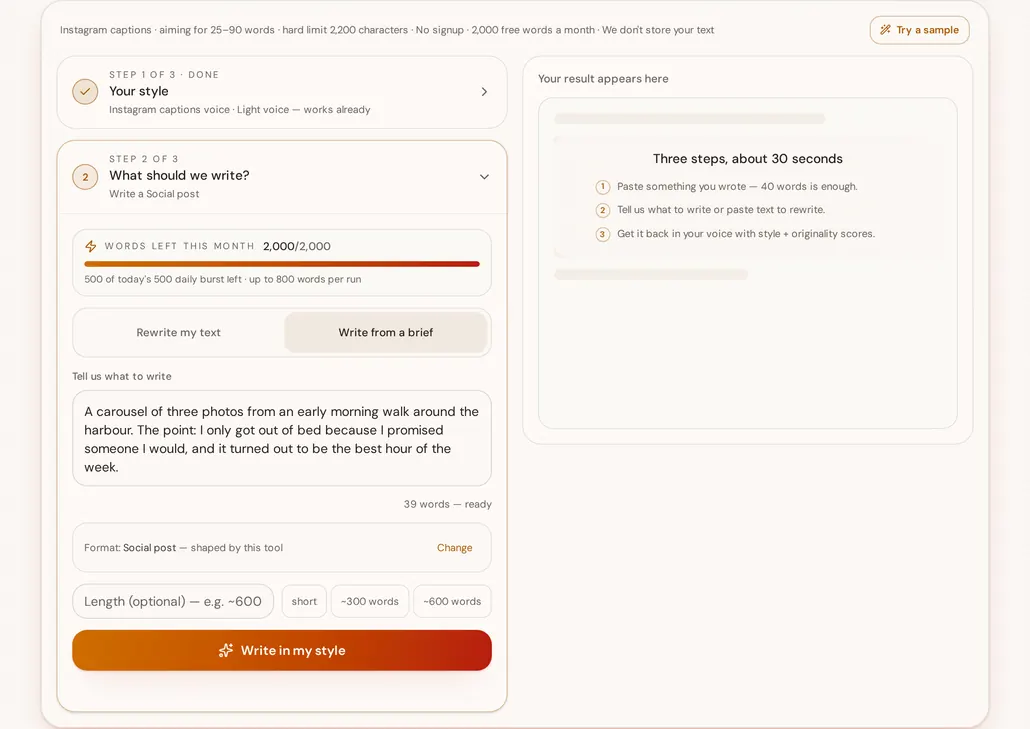
Your result appears here
Three steps, about 30 seconds
- 1Paste something you wrote — 40 words is enough.
- 2Tell us what to write or paste text to rewrite.
- 3Get it back in your voice with style + originality scores.
Free account · 5,000 words a month · We don't store your text
What the Instagram captions does
StyleMimic's Instagram caption generator writes captions in the voice your followers already know, instead of the interchangeable emoji-and-gratitude register most caption tools produce. You paste a batch of your past captions as the style sample — 40 words unlocks it, ten captions give high confidence — describe the post and its point, and you get a 25–90 word caption whose first 125 characters work alone, because that is all that shows before the "more" cut. Emoji appear only at your own rate, hashtags only if you use them (five at most, on their own line), nothing verifiable is invented, and every run is scored for style match and originality. Free with an account.
- Caption length
- 25–90 words, under 2,200 characters total
- Visible hook
- First 125 characters must stand alone before "more"
- Emoji
- Matched to your own rate — none if your captions use none
- Hashtags
- Five at most, on their own line, only if your samples use them
- Ending
- One question or one call to action, never both
- Price
- Free with an account — 5,000 words a month
How it works — three steps, about 30 seconds
- 1Paste a batch of your past captions as the style sample.
- 2Describe the post and the point of it.
- 3Get a caption with your hook style and emoji habit.
Before and after
Generic AI output
✨ Living my best life ✨ So grateful for this beautiful day and all the amazing opportunities coming my way! 💫 #blessed #grateful #vibes #instagood #photooftheday
In the author's style
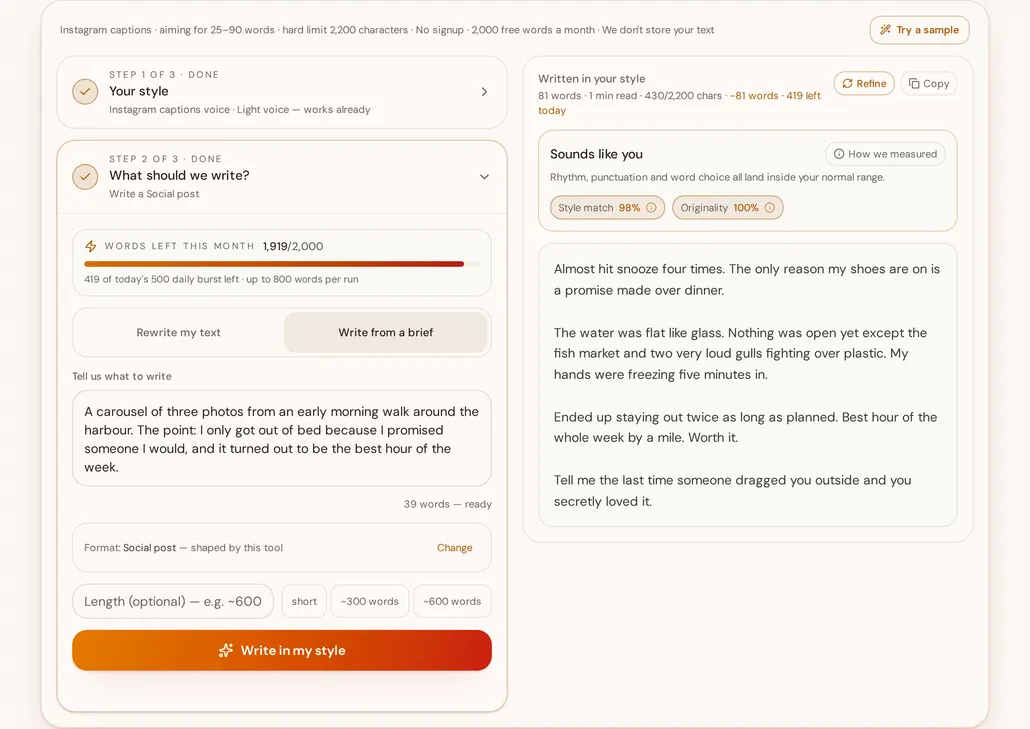
Third try at this shot. The first two had my thumb in them. Sharing the good one and pretending I'm a professional.
- Characters
- 162 → 116 (only ~125 show before "more")
- Words to the first specific detail
- 12 → 1
- Emoji and hashtags
- 2 emoji + 5 hashtags → 0
- Closing asks
- 0 → 0, one implied point instead of three
Hook lands in the first line, keeps the author's self-deprecating tone, and drops hashtags they never actually use.
What you actually see
What an Instagram caption generator actually does
An Instagram caption generator turns "here is the post and here is why it matters" into a caption that works under an image: 25 to 90 words, with the point inside the first 125 characters. The useful version does not describe your photo back to you. The image already carries the information; the caption carries the person, which is the part a generic tool cannot supply and the part it most confidently fakes.
Instagram has its own failure mode. Because captions are short and emotional, the generic register is extremely recognisable: sparkle emoji, gratitude, a vague affirmation, then a block of unrelated hashtags. Followers do not analyse it — they scroll past it. What they do recognise is small: whether you use emoji at all, whether you write in fragments, whether you open with the scene or the conclusion, whether you undercut yourself at the end. Reproducing those habits is worth more than any hook formula.
The truncation rule shapes everything else. A caption can run to 2,200 characters, but roughly the first 125 show before "more", so a caption whose point arrives in sentence four is a caption most people never read. This tool writes front-loaded by contract: the visible opening has to stand alone, hashtags go on their own line at the end and are capped at five, and the caption closes with one question or one call to action — never a stack of both, which is the fastest way to get neither.
The draft is built from captions you have already published. Paste a batch — 40 words unlocks the tool, ten captions give a profile that holds — and the sample is measured: sentence length and variance, fragment rate, punctuation habits, contraction rate, emoji frequency and placement, hashtag habit. That profile goes to the model alongside the format contract, plus a hard rule against invented numbers, quotes, names and sources. Anything factual — the product, the price, the location, the collaborator — comes from your brief.
Two scores come back with every caption. Style match compares the output against your measured profile, including your emoji rate, so you can see whether it sounds like your account before you post. Originality is an n-gram check against your own captions, which matters in short form because a model given ten of your captions will happily hand back an eleventh with the nouns swapped. A words receipt shows the run's cost against your allowance — 5,000 words a month on a free account, which at caption length is a full week of posting or more.
Then edit, and read only the first line first. If the visible part does not make you want the rest, no amount of good writing after the cut will rescue it. Check anything factual yourself, and keep the hashtags you actually use rather than the ones a generator thinks the post deserves. Instagram's own guidance on recommendations and Google's guidance on AI-assisted content both point the same way: original, specific and yours travels further than optimised and interchangeable.
Who uses one
Creators posting daily who run out of caption energy before they run out of photos, small businesses and local shops, photographers who would rather not write, social managers covering several accounts in one day, and ghostwriters keeping a client's account consistent.
What it is not
It is not a scheduler, an autoposter, a hashtag research tool or a growth service. It does not connect to Instagram, does not analyse your reach, and will not invent a discount code or a location to make a caption more concrete. Posting and anything factual stay with you.
How to get a caption worth posting
Paste ten captions rather than one — short-form voice needs width to measure. Say what the post is and, more importantly, why it is worth posting; the point is what the caption needs, not a description of the frame. Pick one ask. Then read the first 125 characters on a phone-width screen before you decide it is done.
Further reading
- Instagram Help Centre: captions and postingInstagram's own documentation of caption limits and post formats — the source for the 2,200-character ceiling and the truncated preview this tool writes to.
- Instagram: how recommendations workInstagram's explanation of ranking and recommendations, and why original, specific captions outperform interchangeable optimised ones.
- Google Search: creating helpful, reliable, people-first contentThe originality standard applied to AI-assisted writing, relevant wherever captions are reused on a website or landing page.
Four tells of generic AI instagram captions output
The emoji-bulleted list caption: a sparkle, a line, a rocket, a line — a slide deck pretending to be a caption.
How we fix it: Emoji frequency and placement are measured from your own captions and reproduced at your rate, so a caption never gets decorated at a rate you do not write at.
Engagement bait as the closer: "Double tap if you agree! 💯 Comment YES below and save this for later!"
How we fix it: The format contract allows exactly one question or one call to action, never both, so the ending asks for one thing in your own phrasing.
Inspirational-quote register: gratitude, "living my best life", an affirmation that would fit under any photo ever taken.
How we fix it: Specifics have to come from the brief and the profile supplies your actual tone, so the caption commits to this post rather than being reusable under the next one.
The hashtag dump: fifteen tags, half of them unrelated to the post, stuck to the end of the sentence.
How we fix it: Hashtags are capped at five, placed on their own line, and only appear at all if your own captions use them — measured from the sample, not guessed from the topic.
What makes a great Instagram captions
- Only the first line and a half is visible — put the hook there.
- Captions carry personality; the image already carries the information.
- Match your own emoji habit rather than a generic influencer one.
- Five hashtags at most, on their own line.
- One ask at the end: comment, save or link — pick one.
What people write with it
Feed captions when the photo is ready and the words are not
The shot is done and the caption is the reason the post sits in drafts for two days. Paste your past captions, say what the photo is and why it mattered, and the draft lands at your usual length with the hook in the visible first line rather than a mood-board sentence.
Reels descriptions that survive the "more" cut
Reels captions get read as one line under a moving video. The first 125 characters have to carry the whole point, so the draft is built front-loaded — context first, detail after the cut, no reveal buried at the bottom where nobody taps.
Carousel intros that make people swipe
A carousel needs a first line that promises something the next slide pays off. Describe the sequence in the brief and the caption sets it up in your voice instead of numbering the slides back at the reader.
Product drops and launch posts without the sales voice
Announcement captions default to a register nobody speaks in. Give the product, the price and the date in the brief — nothing verifiable is invented — and the caption keeps your usual warmth and your one closing ask instead of stacking three of them.
Behind-the-scenes and process posts
These live entirely on voice: the aside, the self-deprecating line, the detail you would normally cut. A measured profile reproduces those habits, which is why a process caption written this way reads like you on a Tuesday and not like a brand account being relatable.
Keep a client or brand account in one voice
If you write captions for someone else, scan their best captions once and save the profile. Every later caption starts from that voice, so a month of posts reads as one person even when three people are drafting.
Questions
Will it add emoji I never use?
No. The emoji habit is measured from your own captions — if you don't use them, the caption won't have them.
Does it generate hashtags?
It adds up to five relevant hashtags on their own line, and none at all if your samples avoid them.
How many captions do I need to paste?
Forty words unlocks generation; ten past captions give a strong profile.
Is it free?
Yes. A free account gives you 5,000 words a month with no card. Captions are short, so that covers weeks of posting, and your style profile is remembered.
How long should an Instagram caption be?
Instagram allows 2,200 characters, but only the first 125 or so show before the "more" cut, so the useful band is 25–90 words with the point inside the visible part. This tool writes to that band and treats the first line as the whole caption for anyone who does not tap.
Does it post or schedule to Instagram?
No. There is no account connection, posting or scheduling — you copy the caption and post it yourself. Instagram's own rules restrict automated posting and engagement, so the tool stays on the writing side of that line.
Related tools
Keep your style in one place
A free account gives you 5,000 words a month and up to 10 saved style profiles. Writing needs an account — scanning a style doesn't.