Facebook Post Generator in your voice
Posts, page updates and group replies that sound like you talking — the conversational register Facebook rewards, not repurposed LinkedIn copy.
Facebook posts · aiming for 40–150 words · Free account · 5,000 words a month · We don't store your text
Your result appears here
Three steps, about 30 seconds
- 1Paste something you wrote — 40 words is enough.
- 2Tell us what to write or paste text to rewrite.
- 3Get it back in your voice with style + originality scores.
Free account · 5,000 words a month · We don't store your text
What the Facebook posts does
StyleMimic's Facebook post generator writes posts, page updates and group replies in your own conversational voice rather than the corporate register most generators default to. You paste a few of your past posts or group replies as the style sample — 40 words unlocks it — describe what you want to say, and the draft comes back at 40–150 words with the point in the first two lines, because that is what shows before "See more". Hashtags are capped at two and only appear if you use them, bullet lists only if your samples have them, nothing verifiable is invented, and each run is scored for style match and originality. Free with an account.
- Post length
- 40–150 words — short enough to read without tapping
- Visible opening
- First two lines carry the post before "See more"
- Register
- Conversational — written to people, not at an audience
- Hashtags
- Two at most, and only if your samples use them
- Invented facts
- Blocked — hours, prices, dates and names come from your brief
- Price
- Free with an account — 5,000 words a month
How it works — three steps, about 30 seconds
- 1Paste a few of your past posts or group replies.
- 2Describe what you want to say.
- 3Get a conversational draft in your voice.
Before and after
Generic AI output
We are pleased to inform our valued customers that our business will be extending its operating hours starting next Monday for your convenience.
In the author's style
We're open till 8 from Monday. Mostly because half of you keep showing up at 6:55 looking hopeful. See you then.
- Words
- 23 → 21 (band 40–150 for longer posts)
- Words to the actual news
- 13 → 4
- Corporate phrases
- 3 ("pleased to inform", "valued customers", "for your convenience") → 0
- Reading grade
- Formal register → conversational, one clause per sentence
Same announcement, but in the owner's actual speaking voice — short, warm, slightly teasing.
What you actually see
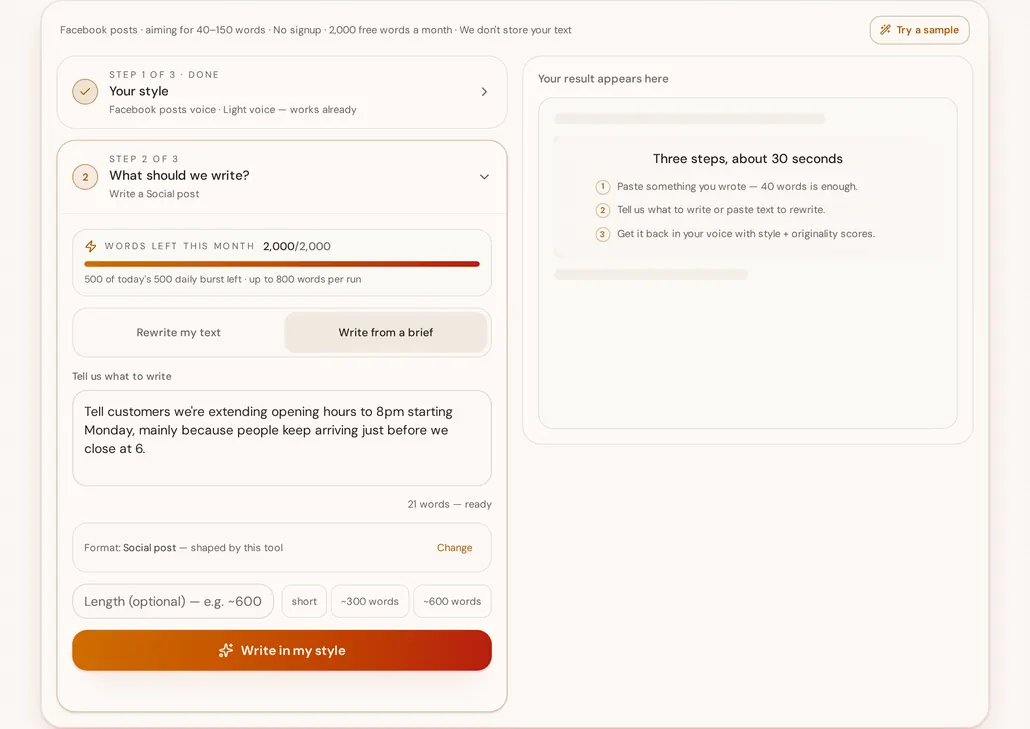
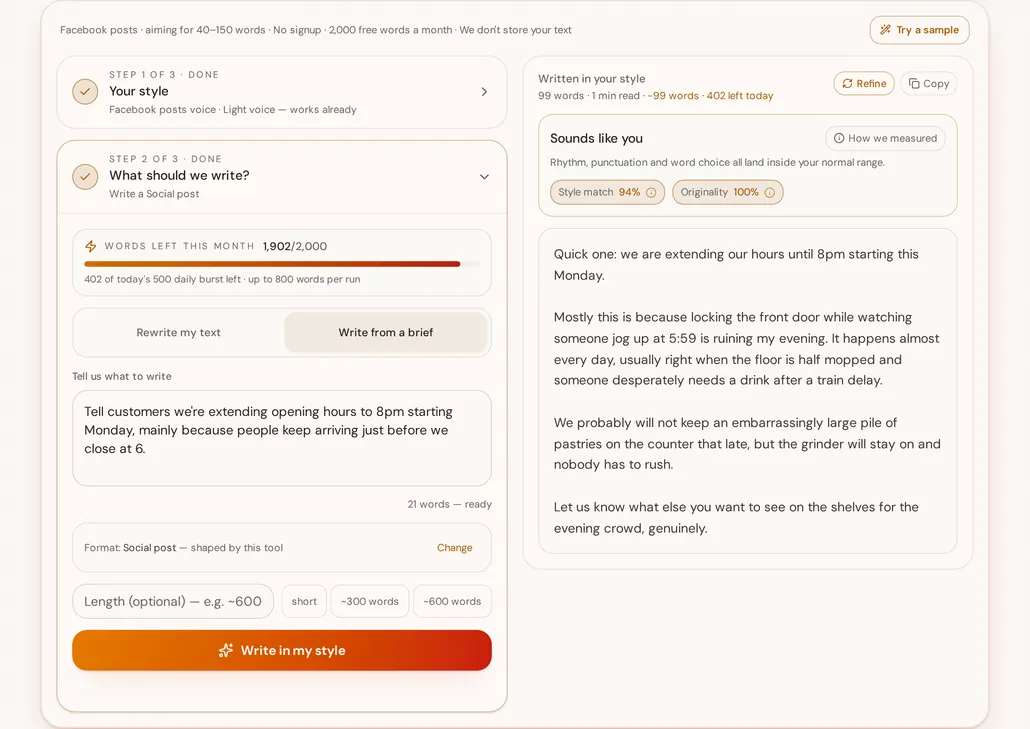
What a Facebook post generator actually does
A Facebook post generator turns a message you need to get out — new hours, an event, a small piece of news — into a post that reads like a person wrote it to people who know them. That last part is the whole difficulty. Facebook is the platform where the corporate register is most obvious and least forgiven, because the surrounding feed is friends, families and local groups, not brands performing thought leadership.
The register is not a style preference; it is how the post performs. Announcements written in institutional voice get scrolled past, while the same information written the way the owner would say it out loud gets comments, and comments are what carry a post further. That is why this tool's format contract is conversational by default: short paragraphs, no bullet lists unless your own samples use them, at most two hashtags and only if you use them, and one closing question rather than a stack of asks.
Length works the same way as on other feeds, but with a lower tolerance. Only the first two lines show before "See more", so a post whose news arrives in the third paragraph is a post most people never read. The band here is 40–150 words with the point up front — short enough to be read without tapping, long enough to carry a story rather than a headline. Facebook posts allow far more, but longer almost never helps outside of a personal update people already care about.
The draft is built from posts you have already written. Paste a few — 40 words unlocks the tool, and group replies are a better sample than page posts if you are writing for a group — and the sample is measured: sentence length and variance, fragment rate, punctuation habits, contraction rate, emoji and hashtag frequency. That profile goes to the model with the format contract and a hard rule against invented facts. Hours, prices, dates, names and locations come from your brief only; the tool does not browse and does not guess.
Each run is scored twice. Style match compares the draft against your measured profile so you can see whether the register is yours before you post — this is the score that catches a draft drifting back toward announcement voice. Originality is an n-gram check against your samples, so a profile built from ten posts does not simply return an eleventh with a few words changed. A words receipt shows the cost against your allowance: 5,000 words a month on a free account, which at this post length is well over a month of regular posting.
Then read it out loud before posting. If a sentence is one you would not say to a customer standing in front of you, cut it — that instinct is more reliable than any score. Check the facts yourself, keep the one aside that makes it sound human, and post it from your own account: Meta's rules and Google's guidance on AI-assisted content both come down to the same thing, which is that the person publishing takes responsibility for what it says.
Who uses one
Local businesses and shop owners posting their own updates, community and group admins, event organisers, page managers handling several accounts, nonprofits, and anyone whose customers are also their neighbours and would notice immediately if the tone changed.
What it is not
It is not a scheduler, an autoposter, an ads tool or a page-growth service. It does not connect to Facebook, does not read your insights, and will not invent opening hours, prices or event details to fill a gap. Posting and every fact in the post remain yours.
How to get a post worth posting
Sample from the right place — group replies for group posts, page posts for page updates. Put every fact in the brief, including the ones you think are obvious. Keep one question at the end and delete the second. Then check that the first two lines alone tell someone what is happening.
Further reading
- Facebook Help Centre: posts and sharingMeta's own documentation of post formats and visibility — the basis for treating the first two lines as the whole post.
- Meta: Community Standards on spam and inauthentic behaviourWhy this tool drafts but never posts, and why generic mass-posted copy is a platform risk as well as a reader problem.
- Google Search: creating helpful, reliable, people-first contentThe usefulness and originality standard for AI-assisted writing, relevant when the same copy is reused on a business website.
Four tells of generic AI facebook posts output
Institutional opener: "We are pleased to inform our valued customers…", "Attention everyone!"
How we fix it: The profile supplies your own opening habit from real posts, and the conversational contract puts the news in the first line instead of a formality frame.
Bullet-listed announcement — a shop update formatted like a product page with three dashes and a bolded header.
How we fix it: Bullet lists are only allowed if your own samples use them, so an update stays in short spoken paragraphs unless that is genuinely how you write.
Stacked asks: "Like, share, comment below, tag a friend and check the link in our bio!"
How we fix it: One closing question or one call to action, never a stack — and phrased the way you ask for things rather than the way campaigns do.
Invented convenience details: hours, prices or dates that sound plausible and are not true.
How we fix it: Anything verifiable has to come from your brief; the model is blocked from filling gaps with numbers, names or dates it does not have.
What makes a great Facebook posts
- Facebook rewards conversation — write to people, not to an audience.
- The first two lines are what shows before 'See more'.
- Stories and specifics outperform announcements.
- Keep it short enough to read without tapping.
- One question at the end invites the comments that spread it.
What people write with it
Local business updates that sound like the owner
Opening hours, a delivery delay, a new item on the menu. Paste your past posts, give the facts in the brief, and the update keeps the warm, slightly teasing tone your regulars already recognise instead of turning into "we are pleased to inform our valued customers".
Group posts and replies that fit the room
Community tone is not page tone. Paste your group replies as the sample and the draft matches how you actually write inside that community — shorter, more direct, without the announcement voice that gets a post ignored or reported as promotional.
Event invites people actually respond to
An invite needs the what, where, when and one reason to come. Put the details in the brief — none of them get invented — and the post carries them in two readable lines with a single ask at the end rather than three.
Personal profile posts you keep meaning to write
News, a milestone, a thank-you, a small story. These are the posts that read worst when generated generically, because friends notice register instantly. A measured profile keeps the asides and sentence rhythm that make it sound like you typed it.
Community moderation and housekeeping notes
Rules reminders and housekeeping posts go badly when they read as either a legal notice or passive aggression. The draft states the thing plainly in your own voice, with the reason attached, which is what keeps a group calm.
Repurpose one message across platforms without one voice fitting all
Save a profile once and reuse it in the LinkedIn, X and comment tools. The voice stays constant while each tool applies its own format, so a Facebook post does not read like LinkedIn copy pasted sideways.
Questions
Does it work for groups as well as pages?
Yes — paste group replies as the sample when you want the tone you use inside a community rather than on a page.
Can I use one profile for several platforms?
Yes. Saved style profiles work in every tool, so the same voice covers Facebook, LinkedIn and comments.
Do you store the posts I paste?
No. Your text is used to build the profile for the request and isn't kept for training.
Is it free?
Yes. A free account includes 5,000 written words a month with no card, and it saves your style profiles between sessions.
How long should a Facebook post be?
Only the first two lines show before "See more", so the practical band is 40–150 words with the point up front. This tool writes to that band and treats the visible opening as the whole post for anyone who does not expand it.
Does it post to Facebook for me?
No. There is no page connection, posting or scheduling — you copy the draft and post it yourself. Meta's platform rules treat automated posting and engagement differently from a person writing their own updates, so the tool stays on the drafting side.
Related tools
Keep your style in one place
A free account gives you 5,000 words a month and up to 10 saved style profiles. Writing needs an account — scanning a style doesn't.